What are PTFE Envelope Gaskets?
A PTFE envelope gasket is a composite gasket
consisting of a PTFE outer envelope with an internal insert (inlay)
The PTFE layer provides excellent chemical resistance,
while the core material adds strength and recovery, combining the benefits of
multiple materials into a single sealing solution
These gaskets are typically used as flange gaskets in
applications requiring high chemical resistance and sealing reliability
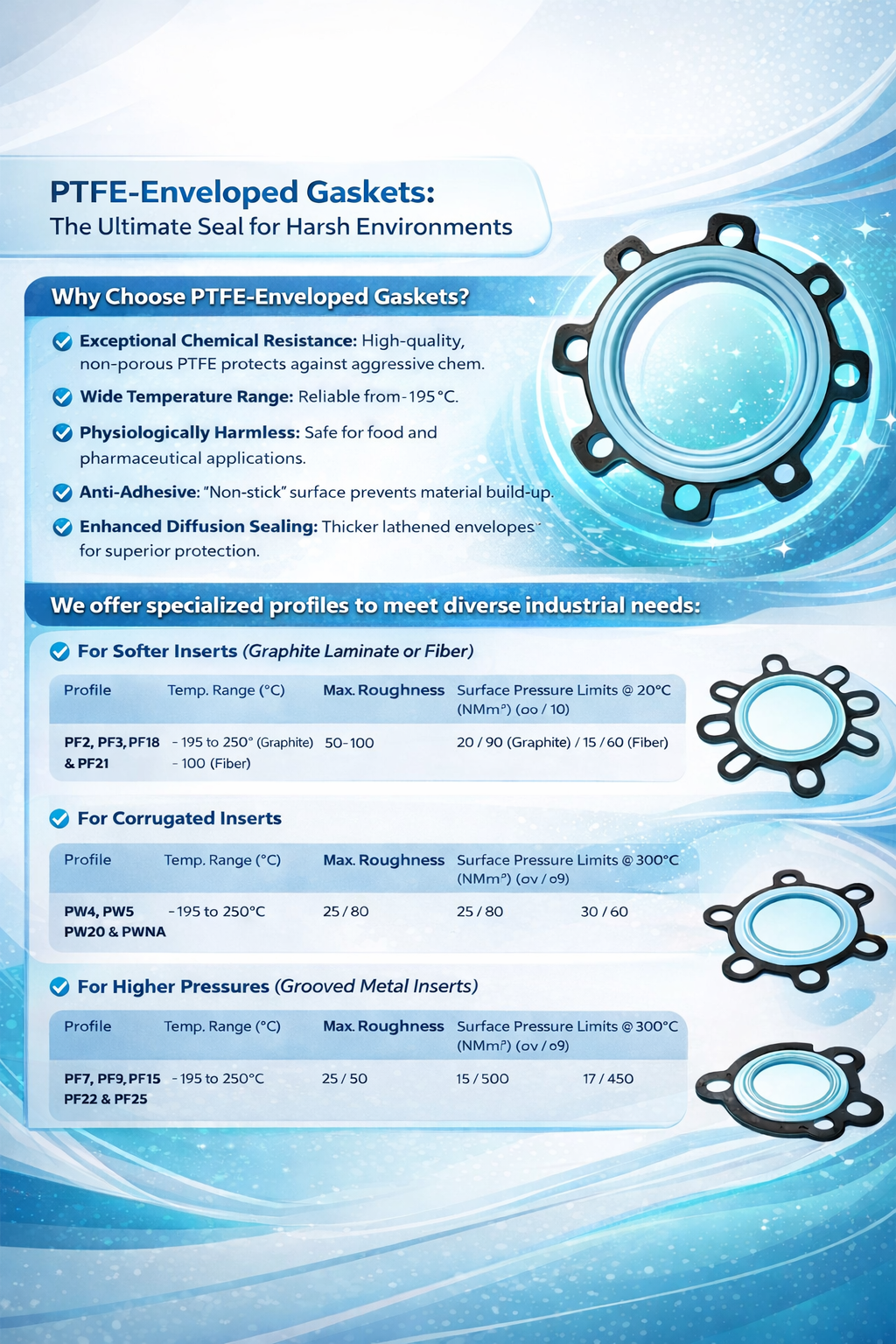
Key Benefits of PTFE Envelope Gaskets
- Outstanding
chemical resistance – PTFE is resistant to most
corrosive media, vapours and fluids
- Wide
temperature capability – suitable for both low and high
temperature environments
- Non-contaminating – ideal for food, pharmaceutical and hygienic processes
- Excellent
sealing performance – reduces leakage in aggressive or
sensitive systems
- Non-stick
surface – prevents material build-up and eases
removal
- Durable
and long-lasting – resistant to ageing, weathering and
degradation
PTFE envelope gaskets are widely used because they
combine chemical inertness with mechanical strength from the insert material
Typical Applications
PTFE envelope gaskets are used across multiple industries
where standard gasket materials may fail:
- Chemical
processing and petrochemical plants
- Pharmaceutical
and food processing systems
- Water
treatment and utilities
- Oil
and gas operations
- Power
generation facilities
- Glass-lined
and enamelled equipment
- Pumps,
valves and pipeline flange connections
They are especially effective in corrosive
environments or where product contamination must be avoided
Types of PTFE Envelope Gaskets
Different envelope styles are available depending on
pressure, media and application:
U-Type Envelope
- Suitable
for medium to high pressures
- Most
commonly used configuration
Double U-Type
- Enhanced
sealing for higher pressures
- Additional
protection where media exposure is critical
C-Type Envelope
- Suitable
for flexible insert materials
- Used
where adaptability is required
V-Type / Slit Envelope
- Cost-effective
solution for lower pressure applications
Donut / Fully Encapsulated
- Used
where media contact on all surfaces must be prevented
Envelope selection depends on flange design, pressure
and sealing requirements.
Inlay (Insert) Materials
The internal core of a PTFE envelope gasket can be
tailored to suit performance needs:
- Compressed
fibre (CNAF)
- Rubber
(EPDM, NBR, etc.)
- Graphite
- ePTFE
- Corrugated
metal inserts (for higher pressure applications)
The insert provides mechanical strength and resilience,
while the PTFE envelope protects against chemical attack
When to use PTFE Envelope Gaskets
PTFE envelope gaskets are ideal when:
- The
media is highly corrosive or aggressive
- Cleanliness
or hygiene is critical
- Standard
gasket materials degrade or contaminate
- Flanges
include glass-lined, plastic or coated surfaces
- A
combination of chemical resistance and mechanical strength is
required
They are commonly selected where traditional rubber or
fibre gaskets cannot provide sufficient resistance or longevity.
Custom PTFE Envelope Gaskets
Ashton Seals can supply:
- Standard flange sizes (DIN, ANSI, BS)
- Bespoke
gaskets to drawings or samples
- Various
envelope types and insert materials
- Small
batch or production quantities
We can also assist with material selection based on
temperature, pressure and chemical compatibility.
Related Sealing Products
You may also be interested in:
- PTFE
Gaskets
- Compressed
Fibre Sheet (CNAF)
- Graphite
Gaskets
- Rubber
Sheet Materials
- Gasket
Manufacturing Services
Frequently Asked Questions
1. What is the advantage of a PTFE envelope
gasket?
PTFE envelope gaskets provide excellent chemical
resistance while maintaining strength and resilience through the internal
insert.
2. Where are PTFE envelope gaskets used?
They are commonly used in chemical, pharmaceutical, food,
water treatment and industrial processing systems.
3. Are PTFE envelope gaskets suitable for food
applications?
Yes. PTFE is non-reactive and suitable for hygienic
applications when manufactured to the correct standards.
4. What is the difference between PTFE and
standard gaskets?
Standard gaskets are made from a single material, whereas
PTFE envelope gaskets combine a chemical-resistant outer layer with a stronger
internal core.